The European Electronic Games Association (Video Game Europe) and the European Federation of Game Developers (EGDF) have recently launched the European Electronic Games Report 2024, which covers a number of aspects, including income, jobs and number of players, and reveals the current situation in the European video game industry.
The report is based on Ipsos GameTrack data, GSD sales statistics and the EGDF-VGE industry insight, covering 12,000 online interviewees (6-64 years old) in five major markets, namely France, the United Kingdom, Spain, Italy and Germany, and 1,000 face-to-face national representative surveys per year. The report emphasizes that video games have evolved from entertainment tools to a strategic pillar for the digital future of Europe, with industry growing by 15 per cent over the past five years and practitioners growing by 7 per cent in 2023.
The data shows that:The total income of the European video game industry in 2024 amounted to 26.8 billion euros (approximately 22.31 billion yuan yuan), an increase of 4 per cent over the same period. The mobile end accounted for 44 per cent (41 per cent in 2023), the mainframe for 38 per cent (41 per cent), the PC for 15 per cent (14 per cent) and on-demand/flow media games for 3 per cent.The share of revenue from the sale of digital games was 90 per cent (85 per cent in 2023), of which the application of internal purchase and payment applications accounted for 43 per cent of the figure (41 per cent in 2023). The five major European markets in France, Germany, Italy, Spain and the United Kingdom received a total of 11.8 billion euros (approximately 98.2 billion yuan) in mobile games in 2024.
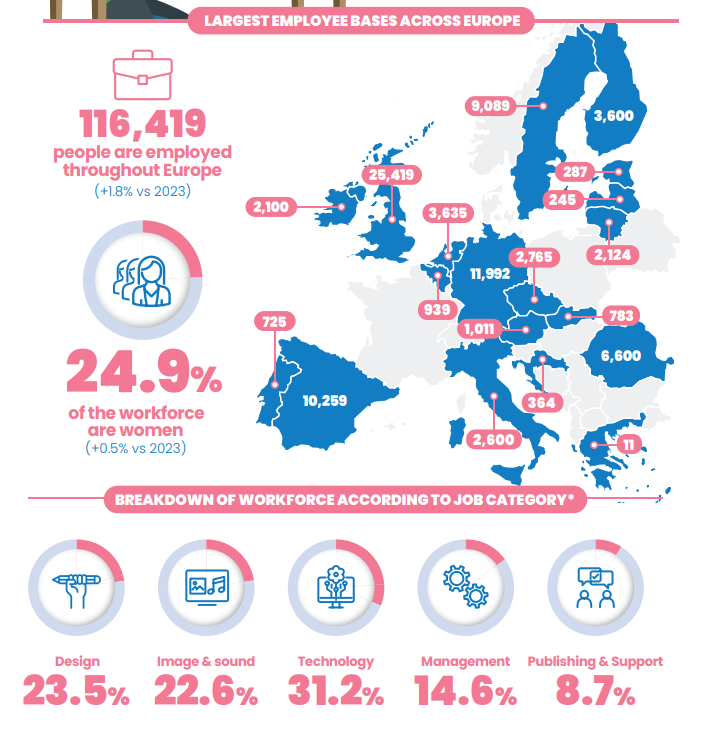
In 2024, there were 11,6419 persons in the European video game industry, an increase of 1.8 per cent over the same period, with women accounting for 24.9 per cent (a 0.5 per cent increase). Labour force distribution: technology accounted for 31.2 per cent, graphics and sound 22.6 per cent, design 23.5 per cent, management 14.6 per cent, distribution and marketing 8.7 per cent.
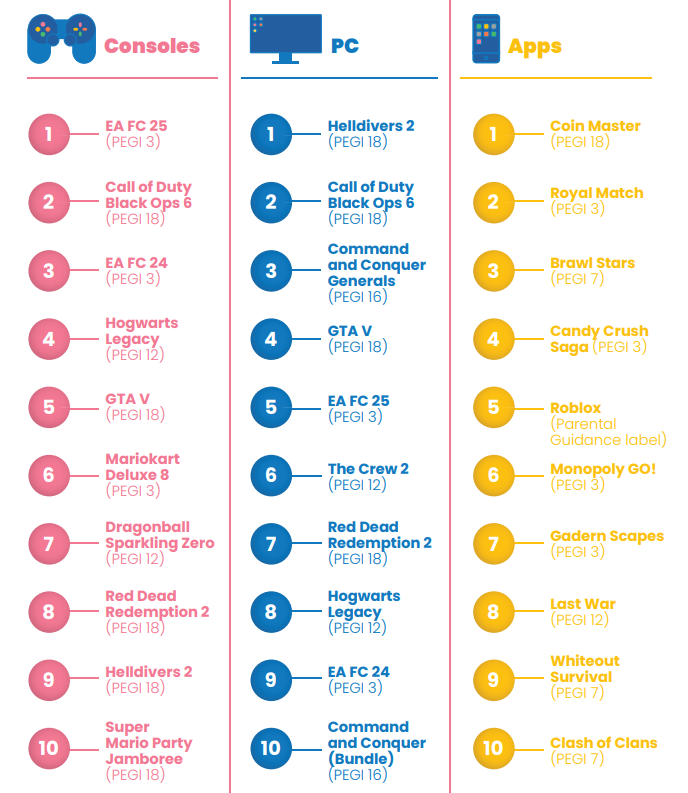
The digital transformation of the game industry is highlighted by the fact that Europe as a whole currently has over 6,000 play studios and 90 per cent of income is digitized. The five market bestsellers list shows that the EAC 25, Mission Call: Black Action 6, Harry Potter: Hogwarts Heritage, Hellguard 2 and GTA 5 are leading the end and host markets. “Master of Gold, Royal Wars, Sweet Legends and Roblox, among others, lead the way.” In the area of exports, while the report does not detail specific figures, it emphasizes the strong European game exports, which support cultural diversity and global competitiveness.
According to the report, 54 per cent of the population aged 6-64 in Europe in 2024 (approximately 128.3 million people) played video games, 75 per cent of whom were adults (over 18 years).The average age of a player is 31 years, with 45 per cent of women playing and an average age of 32. The distribution is as follows: Germany, 35.9 million; France, 30.8 million; United Kingdom, 25.5 million; Spain, 22.1 million; and Italy, 14 million.
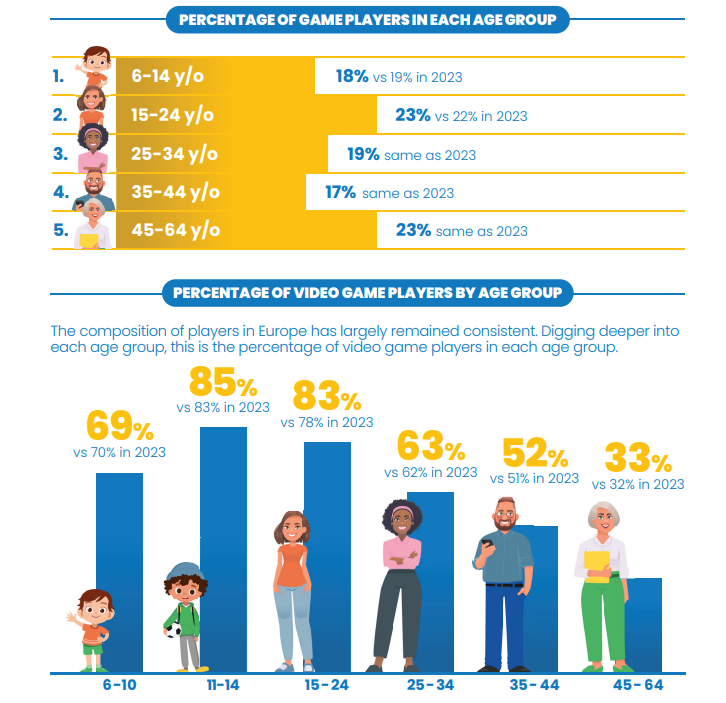
The age group participation rate continues to increase: 69 per cent of children aged 6 to 10 years (a slight decrease of 1 per cent compared to 2023) are play players, 85 per cent are 11 to 14 years old, 83 per cent are 15-24 years old, 63 per cent are 25 to 34 years old, 52 per cent are 35 to 44 years old and 33 per cent are 45 to 64 years old. Among the players, 18 per cent are 6-14, 23 per cent are 15-24, 19 per cent are 25-34, 17 per cent are 35-44 and 23 per cent are 45-64.
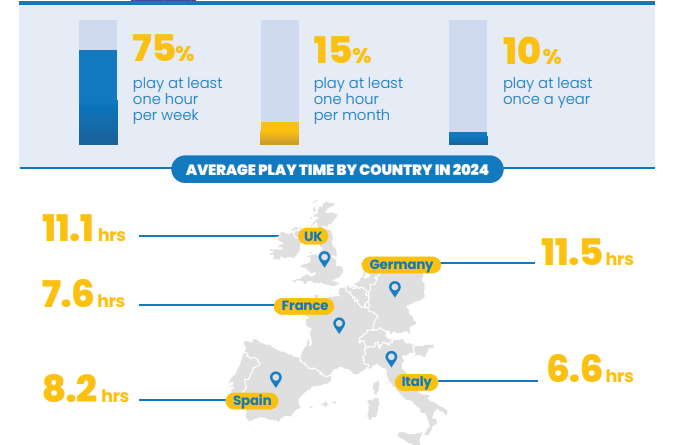
European players spend 9.4 hours a week playing games (11.5 hours in Germany, 7.6 hours in France, 8.2 hours in Spain, 11.1 hours in the United Kingdom and 6.6 hours in Italy) and 16.75 and 23 hours on social media and television, respectively. The percentage of players playing at least one hour a week is 75 per cent. In the use of equipment, 71 per cent of players use smartphones/platforms (3 per cent litres compared to 2023), 59 per cent use mainframe play (3 per cent increase) and 43 per cent use PC (3 per cent decrease). In addition, 76 per cent of female players play with mobile devices, with the share of both the mainframe (55 per cent) and the PC (35 per cent) being below average.
The types of hot games vary from one facility to another: hosts prefer racing (31 per cent), sports (28 per cent) and adventure (28 per cent); PC players prefer adventure (23 per cent), shooting (20 per cent) and strategy (18 per cent); mobile ends are dominated by intelligence/puzzle (25 per cent), role-playing/strategy (17 per cent) and text games (17 per cent).
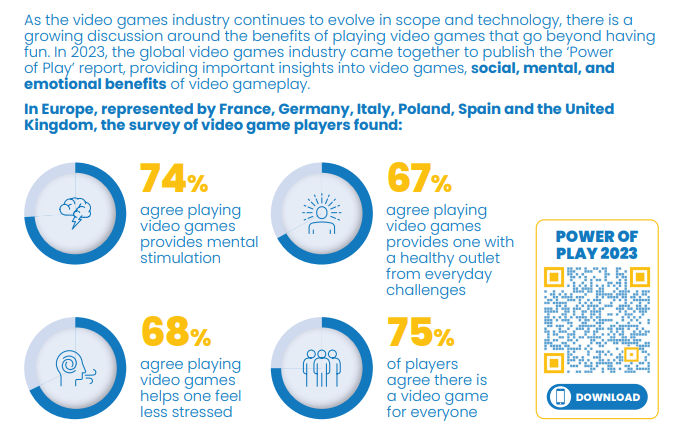
Most players think that playing games is of significant benefit to them: Seventy-four per cent of the players agreed that the game provided a spiritual stimulus, 68 per cent thought that playing would reduce pressure, 67 per cent thought that playing was an effective means to relieve life pressure, and 75 per cent believed that “everyone has the right game”.
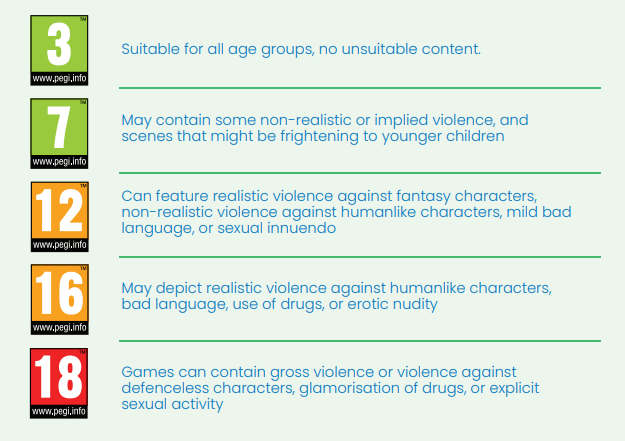
As the game industry continues to develop, the game will become more regularized and legalized, with PEGI operating in 40 countries since 2003, covering more than 2,800 member companies and 4.38 million games and millions of applications. Eighty per cent of parents are aware of the PEGI label, 70 per cent of the parents of play-players are aware, 27 per cent make decisions on this basis and 53 per cent follow the recommendations. The 2024 PEGI Guidelines were updated, focusing on monetization of games and online security, with fines ranging from 50,000 to 500,000 euros.
Ninety-five per cent of parents monitor the consumption of children in the game, and the average expenditure of children allowed to consume has fallen by 21 per cent, and 76 per cent of children do not purchase the content of the game. The industry is committed to transparent trading, fair refunds, skinless gambling, and to providing parental control tools: Sixty-seven per cent of parents use this tool to limit their children ‘ s play time. Xbox, PlayStation, Nintendo and platforms such as Roblox, EA have young player accounts and voice clearances. Resources include VGE’s Five Parents’ Alert, which covers several European countries in many languages.